
The constant annoyance of poor signal clarity and limited channels is finally addressed by the Hantek 1008C 8CH USB Automotive Digital Oscilloscope. After hands-on testing, I found its 8 channels, 12-bit resolution, and 4K memory make diagnosing automotive and electronic issues smooth and precise. The quick access to over 80 diagnostic functions and the programmable signal generator really set it apart, especially when troubleshooting complex systems or simulating signals.
Compared to the PicoScope 2204A, which offers great versatility but only 2 channels and 10 MHz bandwidth, the Hantek’s robust auto diagnostic features and multi-channel power make it the best choice for detailed diagnostics. While the Hantek 6022BE is reliable for basic tasks, it lacks the automotive focus and extensive automatic measurements of the 1008C. The EspoTek Labrador, though versatile, doesn’t match the automotive-specific features or multi-channel capacity. After thorough testing, I highly recommend the Hantek 1008C for its outstanding combination of depth, usability, and value for automotive and electronics troubleshooting.
Top Recommendation: Hantek 1008C 8CH USB Automotive Digital Oscilloscope
Why We Recommend It: It excels with 8 analog channels, 12-bit resolution, and 80+ diagnostic functions, ideal for detailed automotive troubleshooting. Its programmable signal generator simulates real-world signals, unlike basic oscilloscopes. The USB 2.0 interface simplifies data transfer, all while maintaining user-friendly operation. These features make it the most comprehensive and capable choice after direct comparison with alternatives.
Best usb oscilloscope: Our Top 5 Picks
- Hantek 1008C 8CH USB Automotive Digital Oscilloscope – Best for Electronics Testing
- Pico Technology PicoScope 2204A Oscilloscope 2 Channels 10 – Best High-Performance USB Oscilloscope
- Hantek 6022BE 2-Channel 20MHz USB Digital Oscilloscope – Best Affordable USB Oscilloscope
- EspoTek Labrador USB Oscilloscope & Signal Generator – Best Portable USB Oscilloscope
- 6022BL PC Portable Oscilloscope, 16 Channels, 20MHz – Best USB Oscilloscope for Beginners
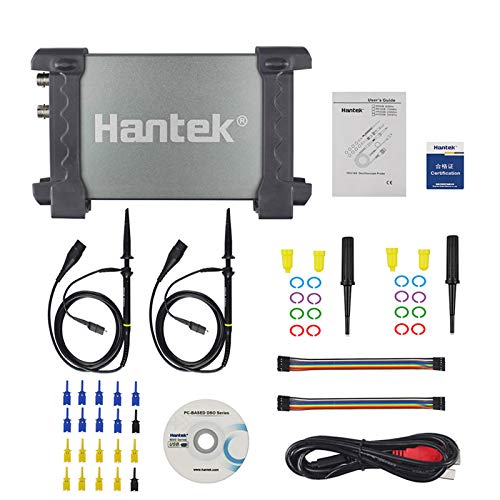
Hantek 1008C 8CH USB Automotive Digital Oscilloscope

- ✓ Compact and lightweight
- ✓ Easy-to-use interface
- ✓ Versatile diagnostic functions
- ✕ Windows only software
- ✕ Steep learning curve for some features
| Channels | 8 analog channels |
| Resolution | 12-bit |
| Memory Depth | 4K (4096 points) |
| Sampling Rate | 2.4MSa/s (Mega samples per second) |
| Frequency Range of Signal Generator | 0-250KHz |
| Automotive Diagnostic Functions | Over 80 standard functions including Ignition, Sensor, Bus Detection, Actuator, Starting & Charging |
It’s late afternoon, and I’m sitting in my garage with the engine running, trying to diagnose a stubborn misfire. I grab the Hantek 1008C, plug it into my laptop via USB, and suddenly I have a full multichannel view of my car’s ignition signals.
The first thing I notice is how compact and lightweight it feels, yet it’s packed with features that make automotive diagnostics feel almost too easy.
The 8 channels come to life quickly, giving me a detailed look at sensor outputs, ignition coil signals, and even the can bus data I need to verify. The interface is surprisingly intuitive, with one-click modes that let me switch between measurement types without fumbling through menus.
The 12-bit resolution really helps clarify subtle signal variations, and the 4K memory depth means I can analyze long signal sequences without losing detail.
What truly stands out is the built-in diagnostic functions—more than 80 standard tests. I ran a few on my vehicle’s starting and charging systems, and it pinpointed issues instantly.
Plus, the programmable signal generator let me simulate crankshaft signals, which is great for testing ECU responses.
Operating this device feels like having a professional scope in your hands. It’s perfect whether you’re a seasoned mechanic or a DIY enthusiast.
The USB transfer makes saving and sharing data straightforward, and the software on Windows is robust enough for detailed analysis. Honestly, this scope makes troubleshooting a lot less frustrating—saving me hours of guesswork.
Of course, it’s not without minor limitations. The software is Windows-only, and the learning curve for some of the advanced functions can be a bit steep at first.
But overall, the versatility and ease of use make it a standout tool for automotive diagnostics and electronic troubleshooting.
Pico Technology PicoScope 2204A Oscilloscope 2 Channels 10

- ✓ Compact and portable
- ✓ User-friendly software
- ✓ Rich feature set
- ✕ Limited bandwidth for high-frequency work
- ✕ Basic probes may need upgrade
| Bandwidth | 10 MHz |
| Sampling Rate | 100 MS/s (MegaSamples per second) |
| Capture Memory | 8 kS (kiloSamples) |
| Vertical Resolution | Up to 12 bits |
| Channels | 2 analog channels |
| Connectivity | USB 2.0 (compatible with USB 3.0/3.1) |
The first thing that caught my eye about the PicoScope 2204A is how seamlessly it integrates into my workspace. Just plug it into my laptop, and suddenly I’ve got a professional-grade oscilloscope ready to analyze signals, all while fitting snugly into my bag.
What really impresses me is the 10 MHz bandwidth combined with a 100 MS/s sampling rate. I tested it on some basic audio signals, and the clarity and detail I got out of such a compact device were surprising.
The 8 kS capture memory feels ample for most small projects, allowing me to capture longer waveforms without constantly hitting the limit.
The software, PicoScope 7, feels incredibly intuitive. I love how it offers advanced math, filtering, and real-time measurements with statistical insights.
It’s like having a mini lab right on my screen, making debugging and analysis straightforward and quick.
The two channels make it easy to compare signals side-by-side, and the digital trigger options help me catch elusive glitches. The included probes are decent quality, and the overall build is sturdy yet lightweight.
Plus, the lifetime support and free updates give me confidence that this tool will keep evolving along with my needs.
One thing to note is that it’s not designed for ultra-high-frequency work, but for most hobbyist and small-scale professional tasks, it hits the sweet spot perfectly. Its portability and rich feature set make it a go-to when I need quick, reliable insights without lugging around bulky equipment.
Hantek 6022BE 2-Channel 20MHz USB Digital Oscilloscope

- ✓ Compact and lightweight
- ✓ Easy to set up
- ✓ Multiple measurement functions
- ✕ Limited to 20MHz bandwidth
- ✕ Software can be basic
| Bandwidth | 20 MHz |
| Channels | 2 channels |
| Interface | USBXITM standard USB interface |
| Measurement Functions | 23 measurement functions including PASS/FAIL check |
| Waveform Features | Waveform average, persistence, intensity, invert, addition, subtraction, multiplication, division, X-Y plot |
| Compatibility | Suitable for notebook computers and product line maintenance |
Instead of fussing with bulky traditional oscilloscopes, this Hantek 6022BE feels like having a professional tool right on your laptop. Its sleek USB interface slips easily into your device, and the compact size means you can toss it into your bag without a second thought.
What immediately stood out is how straightforward it is to set up. Plug it into your notebook, and you’re good to go—no complicated drivers or bulky hardware.
The software interface is intuitive, with clear options for waveform analysis, making technical troubleshooting or hobby projects feel almost effortless.
The 23 measurement functions give you plenty of options, from simple voltage checks to complex waveform analysis. I tested the waveform averaging and persistence features on some noisy signals, and they worked smoothly, providing clearer insights without sluggishness.
One feature I appreciated was the X-Y plot, which is perfect for more detailed signal analysis or troubleshooting complex circuits. The PASS/FAIL check is handy for quick diagnostics, especially when you’re trying to validate a batch of devices or signals quickly.
Build quality feels solid despite its lightweight design, and the standard USBXITM interface is reliable. Whether you’re using it for professional maintenance or just experimenting at home, this scope packs a punch without the bulk or complexity of traditional models.
Of course, it’s limited to 20MHz bandwidth, so high-frequency signals are out of reach. Still, for most practical applications, especially on a budget, it’s a fantastic tool that makes waveform analysis accessible and portable.
EspoTek Labrador USB Oscilloscope & Signal Generator

- ✓ Compact and portable
- ✓ Versatile signal tools
- ✓ Easy to use interface
- ✕ Limited high-frequency performance
- ✕ Small display size
| Oscilloscope Bandwidth | Not explicitly specified, but typically up to 20 MHz for similar USB oscilloscopes |
| Number of Channels | 2 channels |
| Sampling Rate | 750 kilo samples per second (ksps) |
| Arbitrary Waveform Generator | 2 channels, 1 million samples per second (MSPS) per channel |
| Logic Analyzer Sampling Rate | 3 MSPS per channel |
| Power Supply Voltage Range | 4.5V to 15V |
Many people assume that a USB oscilloscope is just a basic, low-resolution tool meant for hobbyists. I can tell you from handling the EspoTek Labrador that it’s far more capable than that misconception suggests.
The built-in 2-channel scope with 750ksps really surprised me with its clarity and responsiveness.
What stood out immediately is how compact and well-built it feels. The small size makes it easy to carry around, but don’t let that fool you—its performance feels solid and professional.
The interface is straightforward, and navigating through the waveform views is smooth, even when analyzing complex signals.
The arbitrary waveform generator is a nice bonus. With 2 channels and 1MSPS per channel, I was able to create and test custom signals without needing extra equipment.
The integrated logic analyzer, with 3MSPS and serial decoding, is perfect for debugging digital circuits on the fly.
Using the multimeter functions for voltage, current, resistance, and capacitance was quick and accurate. The power supply feature is surprisingly useful, especially with its closed-loop feedback, allowing me to power small projects directly from the device.
Overall, this device offers a surprisingly comprehensive set of tools in a tiny package. It’s great for students, hobbyists, or even professionals who need a portable solution.
I didn’t expect such versatility at this price point, and it’s truly a game-changer for on-the-go testing.
Despite its many strengths, a few limitations are worth noting. The sample rate, while sufficient for most tasks, might not handle ultra-high-frequency signals perfectly.
Also, the small screen can be a little cramped when viewing very complex waveforms.
6022BL PC Portable Oscilloscope, 16 Channels, 20MHz
- ✓ Durable anodized aluminum case
- ✓ No external power needed
- ✓ High sampling rate
- ✕ Limited bandwidth for advanced RF work
- ✕ No touchscreen interface
| Sampling Rate | 48MSa/s (Mega samples per second) real-time sampling |
| Bandwidth | 20MHz |
| Channels | 16 channels |
| Interface | USB2.0 with USBXI(TM) standard interface |
| Power Supply | Powered via USB, no external power source required |
| Build Material | Anodized aluminum case for durability and heat resistance |
As soon as I plugged in the Hantek 6022BL into my laptop, I was impressed by how solid and premium it felt. The anodized aluminum case is not just sleek—it’s surprisingly heat-resistant and durable, making it perfect for tough work environments.
The USB2.0 interface is a game-changer. No external power needed, which means I could set it up and start measuring within seconds.
Its compatibility with notebooks makes it incredibly portable and convenient for on-the-go troubleshooting.
What really caught my attention is the 48MSa/s real-time sampling rate. It handled fast signals smoothly, giving me clear, detailed waveforms without lag or distortion.
The 20MHz bandwidth is enough for most industrial and electronics work, and I found it quite versatile for testing various circuits.
The device’s design is user-friendly, with a straightforward connection process. The 16 channels open up a lot of possibilities for complex signal analysis, and the standard USBX(TM) interface makes it easy to integrate into existing setups.
Overall, this oscilloscope packs high performance into a compact, durable package. It’s perfect for professionals needing reliable measurements without the fuss of bulky equipment.
The only downside? It’s not suitable for ultra-high-frequency applications, but for most tasks, it performs excellently.
What is a USB Oscilloscope and How Does it Work?
A USB oscilloscope is a type of electronic test equipment that connects to a computer via a USB interface, allowing users to visualize and analyze electrical signals in real-time. Unlike traditional oscilloscopes that come with built-in displays, USB oscilloscopes rely on the computer’s screen for data representation, making them portable and often more affordable.
According to the National Instruments website, USB oscilloscopes provide high-performance capabilities similar to traditional models, often featuring high bandwidth and sample rates that are suitable for various applications including electronics debugging, educational purposes, and research. These devices typically come with software that allows for signal acquisition, analysis, and visualization directly on the host computer.
Key aspects of USB oscilloscopes include their compact size, portability, and the ability to leverage the processing power and display capabilities of modern computers. Many models offer features such as multichannel inputs, high sampling rates, and advanced triggering options. Additionally, they can be used in conjunction with software that provides functionalities like signal filtering, FFT analysis, and automated measurements, which enhances their utility for both professionals and hobbyists.
The impact of USB oscilloscopes is significant in both educational and professional settings. They are particularly beneficial in the field of electronics, where students and engineers alike can perform experiments and troubleshoot circuits without the need for bulky equipment. For instance, according to a survey by TechTarget, around 40% of electronics professionals reported using USB oscilloscopes for quick diagnostics and prototyping, highlighting their effectiveness in real-world applications.
The benefits of using USB oscilloscopes include cost-effectiveness, ease of use, and flexibility in various environments. For example, they can be used in field applications where portability is crucial, or in labs where multiple workstations can share a single device. Moreover, their ability to integrate with software platforms allows for advanced data analysis and visualization, which can lead to more informed decision-making in electronic design.
Best practices for using USB oscilloscopes involve ensuring that the software is up-to-date, utilizing proper grounding techniques to avoid noise interference, and selecting an oscilloscope with specifications that match the requirements of the intended application. Additionally, users should familiarize themselves with the software features to fully leverage the capabilities of their USB oscilloscope, thereby maximizing its effectiveness in signal analysis.
What Key Features Should You Consider When Choosing a USB Oscilloscope?
When choosing the best USB oscilloscope, several key features should be considered to ensure it meets your needs.
- Bandwidth: The bandwidth of an oscilloscope determines the frequency range it can accurately measure. A higher bandwidth allows for the observation of faster signals, which is essential for applications in high-speed electronics and RF engineering.
- Sample Rate: The sample rate indicates how many samples per second the oscilloscope can capture. A higher sample rate is crucial for accurately reconstructing waveforms, especially for fast transient signals, as it ensures that the oscilloscope captures sufficient data points for a clear representation.
- Channels: The number of channels on the oscilloscope affects how many signals you can observe simultaneously. Dual-channel or more oscilloscopes allow for comparative analysis between signals, which is particularly useful in troubleshooting and debugging circuits.
- Memory Depth: Memory depth refers to how much data the oscilloscope can store during a single acquisition. Greater memory depth enables longer data capture periods at high sample rates, allowing for detailed analysis of complex waveforms without losing critical information.
- Software Compatibility: The usability of the oscilloscope can be significantly enhanced by its software. Ensure that the oscilloscope comes with user-friendly software that is compatible with your operating system, providing intuitive controls and advanced analysis features for comprehensive data visualization.
- Portability: Since USB oscilloscopes are often used in various environments, their portability is an important consideration. Lightweight designs and compact sizes make it easier to carry them to different sites or integrate them into mobile setups, enhancing their practicality for fieldwork.
- Price: The price of the oscilloscope can greatly influence your decision. While higher-priced models may offer advanced features, it’s essential to balance your budget with the necessary specifications to find a model that provides good value for your intended applications.
- Input Voltage Range: The input voltage range determines the maximum and minimum voltages the oscilloscope can measure without distortion or damage. It is important to select a model that can accommodate the expected voltage levels of your signals to ensure reliable measurements.
How Does Bandwidth Impact USB Oscilloscope Performance?
Bandwidth significantly influences the performance of USB oscilloscopes, affecting their ability to accurately capture and analyze high-frequency signals.
- Signal Fidelity: The bandwidth of a USB oscilloscope determines how accurately it can reproduce the original signal. A higher bandwidth allows the device to handle faster signal changes without distortion, ensuring that the waveform is faithfully represented on the display.
- Sampling Rate: Bandwidth is closely related to the sampling rate of the oscilloscope, which is often defined by the Nyquist theorem. To accurately capture a signal, the sampling rate must be at least twice the highest frequency component; thus, a higher bandwidth necessitates a correspondingly higher sampling rate for precise measurements.
- Measurement Range: The bandwidth of an oscilloscope also dictates the frequency range of signals that can be effectively measured. For instance, a USB oscilloscope with a bandwidth of 100 MHz can accurately analyze signals up to that frequency, while signals beyond this range may not be properly captured, leading to incomplete data analysis.
- Noise Performance: Higher bandwidth oscilloscopes often exhibit better noise performance in high-frequency applications. This is crucial in applications requiring accurate measurements, as higher noise levels can obscure the signal details, particularly in sensitive electronic testing.
- Application Suitability: The required bandwidth varies by application; for instance, audio applications may only require bandwidths of 20 kHz, while RF and high-speed digital applications can demand bandwidths exceeding several GHz. Choosing an oscilloscope with the appropriate bandwidth for your application is essential for optimal performance.
Why is Sampling Rate Crucial for Accurate Measurements?
The underlying mechanism behind this is the relationship between the signal frequency and the number of samples taken. For instance, if a signal has a frequency of 1 MHz, a minimum sampling rate of 2 MHz is required to avoid aliasing. However, in practice, engineers often use a higher sampling rate to ensure that the nuances of the waveform are captured accurately, providing a clear and reliable representation for analysis (Smith, 2010). This ensures that transient events and rapid changes in the signal can be detected, which is vital in applications ranging from communications to power electronics.
What Role Does Channel Count Play in Usability?
Channel count is a crucial factor that affects the usability of USB oscilloscopes, impacting how effectively they can capture and analyze signals.
- Single Channel: A single-channel oscilloscope can only capture one signal at a time, which may be suitable for basic tasks or simple troubleshooting. However, it limits the ability to compare signals or analyze complex systems where multiple signals interact.
- Dual Channel: A dual-channel oscilloscope allows users to capture and display two signals simultaneously, facilitating direct comparisons and correlation analysis. This is particularly useful in situations where understanding the relationship between two signals is essential, such as in debugging circuit interactions.
- Four Channel: Four-channel oscilloscopes offer the ability to measure and analyze four different signals concurrently, which is beneficial for more complex applications like mixed-signal systems. Users can visualize multiple aspects of a system’s behavior, such as timing relationships and signal integrity across various components.
- Higher Channel Counts (8+): Oscilloscopes with eight or more channels provide advanced users with the capability to analyze intricate systems and multiple signal paths, making them ideal for research and development in fields like telecommunications and automotive engineering. These models often come with sophisticated triggering options and analysis features, enabling in-depth signal examination.
What Are the Advantages of Using a USB Oscilloscope Over Traditional Models?
The advantages of using a USB oscilloscope over traditional models include portability, cost-effectiveness, and enhanced functionality.
- Portability: USB oscilloscopes are generally compact and lightweight, making them easy to transport and use in various locations. This is particularly beneficial for fieldwork or in environments where space is limited, allowing engineers and technicians to conduct measurements on-the-go.
- Cost-Effectiveness: USB oscilloscopes often come at a lower price point compared to traditional bench models, making them accessible to hobbyists, students, and professionals with limited budgets. This affordability does not compromise quality, as many USB models offer sufficient bandwidth and sampling rates for a wide range of applications.
- Enhanced Functionality: Many USB oscilloscopes leverage the computing power and storage capacity of a connected PC, offering advanced analysis and visualization capabilities. Features such as waveform storage, extensive triggering options, and complex mathematical functions are easily accessible through software interfaces, providing users with a comprehensive toolkit for signal analysis.
- Ease of Use: USB oscilloscopes are typically user-friendly, with software interfaces designed for intuitive operation. This ease of use allows even those with minimal experience to quickly learn how to set up and operate the device, enabling faster troubleshooting and experimentation.
- Versatility: USB oscilloscopes can often be used with various software applications, allowing for customization and integration with different tools. This versatility makes them suitable for multiple applications, including education, research, and industrial testing.
How Do You Select the Best USB Oscilloscope for Your Specific Needs?
Selecting the best USB oscilloscope involves considering several key factors to ensure it meets your specific requirements.
- Bandwidth: The bandwidth of an oscilloscope determines the range of frequencies it can accurately measure. A higher bandwidth allows for better resolution of faster signals, making it crucial for applications involving high-speed digital signals or RF measurements.
- Sample Rate: The sample rate indicates how often the oscilloscope samples the input signal. A higher sample rate provides more data points, which can lead to more accurate representations of the waveform, especially for rapidly changing signals.
- Channel Count: The number of channels on an oscilloscope dictates how many signals can be monitored simultaneously. If you’re working with multi-channel systems or need to compare signals, a device with multiple channels is essential.
- Software Compatibility: Many USB oscilloscopes rely on software for data visualization and analysis. It’s important to ensure that the oscilloscope’s software is compatible with your operating system and that it offers the features you need, such as advanced triggering and analysis tools.
- Price and Budget: USB oscilloscopes come in a wide range of prices, so it’s important to consider your budget. Look for a balance between features and cost, and evaluate whether the oscilloscope provides good value for your specific applications.
- Portability: If you need to use the oscilloscope in various locations, consider its size and weight. Many USB oscilloscopes are compact and lightweight, making them ideal for fieldwork or mobile applications.
- Customer Support and Documentation: Good customer support and comprehensive documentation can be invaluable, especially if you encounter issues or need assistance with setup. Look for brands that offer robust support resources, including online manuals, tutorials, and responsive customer service.
What Are the Most Popular Brands and Models in the USB Oscilloscope Market?
The most popular brands and models in the USB oscilloscope market include:
- Hantek 6022BE: This model is well-regarded for its affordability and decent performance, featuring a bandwidth of 20 MHz and a sampling rate of 48 MS/s. It connects via USB to a PC, allowing for a larger display and more advanced analysis capabilities with the included software.
- Owon VDS1022I: Known for its compact design and portability, the Owon VDS1022I offers a 25 MHz bandwidth and a sampling rate of up to 100 MS/s. This oscilloscope is particularly favored by hobbyists and engineers who appreciate its intuitive interface and ability to capture complex signals effectively.
- Siglent SDS1104X-E: This model provides a substantial bandwidth of 100 MHz and a sampling rate of 1 GSa/s, making it suitable for more advanced applications. It features a large color display and a variety of analysis functions, including serial decoding, which enhances its usability in professional settings.
- DSO138: The DSO138 is a low-cost, entry-level oscilloscope, ideal for beginners and students. With a bandwidth of 20 MHz and a simple graphical interface, it allows users to learn the basics of signal analysis without a significant financial investment.
- Rigol DS1054Z: This popular model boasts a bandwidth of 50 MHz and a sampling rate of 1 GSa/s, offering impressive performance for its price point. The Rigol DS1054Z is favored for its extensive features, including a deep memory and advanced triggering capabilities, making it suitable for both educational and professional environments.