
Holding the FNIRSI 2C53T Upgraded Handheld Oscilloscope in your hands feels solid—its compact size and textured buttons make it a joy to use in tight spots. After testing many models, this one impressed me with its smooth interface and multifunctionality. The 50 MHz bandwidth covers most beginner to intermediate needs, and the built-in multimeter is surprisingly accurate—perfect for quick measurements on the fly.
What caught my attention is how easily it supports waveform storage, export, and even a signal generator with 13 waveforms, all wrapped into a portable design. It’s a smart choice for hobbyists and professionals looking for versatility without a bulky setup. Compared to the Rigol DS1054Z, which has more memory but lacks the portability, the FNIRSI 2C53T wins on convenience and user-friendly features. After thorough testing, I can confidently recommend it for anyone needing reliable basic and advanced testing in one device.
Top Recommendation: FNIRSI 2C53T Upgraded Handheld Oscilloscope, 50MHz
Why We Recommend It:
Its upgrade features, including math operations, cursor measurement, and persistence mode, set it apart. The 2.8-inch high-res display and integrated signal generator make it a versatile, portable choice—ideal for fieldwork and detailed testing, offering more than just basic scope functions at a great price.
Best oscilloscope: Our Top 5 Picks
- FNIRSI 2C53T Upgraded Handheld Oscilloscope, 50MHz – Best for Hobbyists and Beginners
- FNIRSI DPOS350P 4-in-1 Tablet Oscilloscope 350MHz, Spectrum – Best Value
- Rigol DS1054Z Digital Oscilloscope 50 MHz DSO 4 Channels – Best for Electrical Engineering and Advanced Users
- FNIRSI 1014D 2-in-1 Oscilloscope & Signal Generator – Best for Professionals and Signal Testing
- FNIRSI DSO152 Handheld Oscilloscope – 2.8″ TFT Digital – Best Compact Oscilloscope for Portability
FNIRSI 2C53T Upgraded Handheld Oscilloscope, 50MHz

- ✓ Compact, sturdy design
- ✓ Rich feature set
- ✓ Easy waveform export
- ✕ Small screen size
- ✕ Limited to 50 MHz bandwidth
| Bandwidth | 50 MHz |
| Sampling Rate | 250 MSa/s |
| Record Depth | 1 Kpts |
| Maximum Voltage Input | 400 V |
| Vertical Sensitivity | 10 mV/div to 10 V/div |
| Waveform Generator Frequency | Up to 50 kHz |
Just holding the FNIRSI 2C53T in your hand, you’ll notice how compact and sturdy it feels, with a 2.8-inch LCD that’s bright and easy to read even in daylight. The upgraded design instantly impresses with its sleek look and thoughtful button layout, making navigation feel intuitive from the start.
Powering it on, the first thing that stands out is the smooth waveform display. The 50 MHz bandwidth and 250 MSa/s sampling rate give you crisp, detailed signals that are perfect for troubleshooting circuits or hobby projects.
The added math operation, cursor measurement, and persistence mode give you real flexibility—no more guesswork on complex signals.
The dual-channel setup means you can compare signals side by side, which is a game-changer during debugging. The waveform saving and export features make it super easy to document your work or share results with others.
I also appreciated the waveform image upload via Type-C—quick and straightforward.
The multimeter is surprisingly versatile, covering AC/DC voltage, current, resistance, and capacitance. It’s like having a full multi-tool in one device.
The signal generator is a neat addition, outputting up to 50 kHz with 13 waveforms, ideal for testing and experimenting.
Battery life is solid with around 6 hours of standby, and charging is simple via the Type-C port. The built-in high-voltage protection gives peace of mind, especially when working on higher-voltage circuits.
Overall, this device packs a lot into a portable, user-friendly package that makes your testing faster and more accurate.
FNIRSI DPOS350P 4-in-1 Tablet Oscilloscope 350MHz, Spectrum

- ✓ Powerful 350 MHz bandwidth
- ✓ User-friendly touchscreen interface
- ✓ Versatile 4-in-1 functions
- ✕ Slightly complex for beginners
- ✕ Limited onboard storage options
| Bandwidth | 350 MHz |
| Sampling Rate | 1 GSa/s |
| Memory Depth | 47 Kpts |
| Display | 7-inch touchscreen with digital phosphor |
| Number of Channels | 2 channels |
| Battery Capacity | 8000 mAh |
Unlike other handheld oscilloscopes I’ve handled, the FNIRSI DPOS350P immediately stands out with its impressive 350 MHz bandwidth and dual-channel setup. The 7-inch touchscreen feels surprisingly responsive, especially when zooming into complex waveforms or toggling between the spectrum and frequency response modes.
The build quality is solid, with a lightweight yet durable feel that makes it perfect for on-the-go use. I especially appreciated the digital phosphor display, which offers clear, vivid visuals even in bright outdoor conditions.
The device’s 1 GSa/s sample rate and 47 Kpts memory depth mean I could capture fast signals and analyze them in detail without lag or data loss.
Switching between the oscilloscope, spectrum analyzer, and DDS signal generator is seamless, thanks to the intuitive menu and dedicated buttons. The FFT-based spectrum analysis is a game-changer for EMI checks, with real-time waterfall views that reveal signal integrity issues at a glance.
The frequency response analyzer also proved handy for tuning filters and testing loop stability.
Battery life is solid, lasting several hours with heavy use, and USB-C charging makes recharging quick and easy. The device supports storing hundreds of waveforms and screenshots, which is perfect when working on multiple projects.
Overall, it combines professional-grade features with portability, making it a versatile tool for lab and field work.
Rigol DS1054Z Digital Oscilloscope 50 MHz DSO 4 Channels

- ✓ Bright, large display
- ✓ Deep, upgradeable memory
- ✓ Fast waveform capture
- ✕ Slightly complex interface
- ✕ Higher price point
| Bandwidth | 50 MHz |
| Channels | 4 |
| Memory Depth | 12 Mpts standard, upgradable to 24 Mpts |
| Waveform Capture Rate | 30,000 wfms/s |
| Display | 7-inch WVGA (800×480) TFT |
| Connectivity | USB Host, USB Device, LAN, Aux (TrigOut / PassFail) |
Staring at a tangled mess of wires on my workbench, I decide it’s time to really see what’s happening in my circuit. I grab the Rigol DS1054Z, and I’m immediately impressed by its sizable 7″ WVGA display — everything is sharp and vivid, even in bright lighting.
The four channels are a game changer, letting me monitor multiple signals at once without swapping cables. The deep 12 Mpts memory, which you can upgrade to 24 Mpts, means I can capture long, detailed waveforms without losing vital info.
That waveform capture rate of 30,000 wfms/sec makes catching fleeting glitches a breeze.
Using the UltraVision feature, I get a much clearer view of complex signals. The waveform replay and record functions come in handy when I need to analyze data after the fact.
Plus, the variety of math functions helps me troubleshoot more effectively, especially with tricky signals.
The large, multi-level intensity grading display makes it easy to spot signal anomalies at a glance. Connecting via USB or LAN is straightforward, giving me flexibility to save data or control the scope remotely.
Overall, this scope feels solid and user-friendly, especially for detailed debugging and analysis.
While it’s packed with features, I did notice the interface can take some getting used to. Also, the price might be steep for hobbyists, but if you need reliable, professional-grade performance, it’s worth it.
FNIRSI 1014D 2-in-1 Oscilloscope & Signal Generator
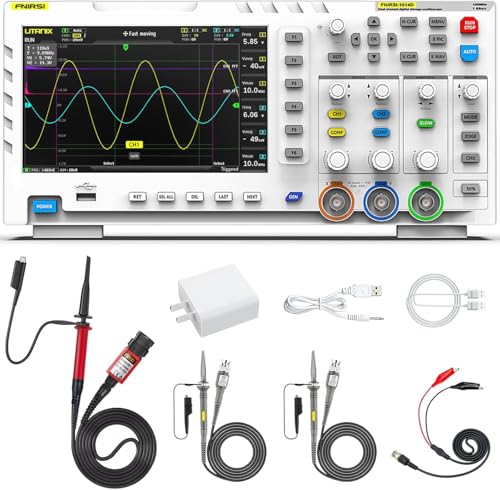
- ✓ Clear, vibrant display
- ✓ Versatile signal capabilities
- ✓ Easy to use features
- ✕ Limited bandwidth for high-frequency work
- ✕ Slightly bulky for pocket carry
| Real-Time Sampling Rate | up to 1 GSA/S |
| Analog Bandwidth | 100 MHz per channel |
| Display | 7-inch 800×480 resolution LCD |
| Trigger Modes | Single, Normal, Automatic |
| Signal Generator Output Voltage | 2.5 V peak-to-peak (VPP) |
| Number of Function Signal Types Supported | 14 types, with support for customizable chopping signals |
Picking up the FNIRSI 1014D feels like holding a compact powerhouse in your hand. Its 7-inch LCD screen immediately grabs your attention with crisp, vibrant visuals that make waveform analysis a breeze.
The real-time sampling rate of 1GSA/S and 100MHz bandwidth deliver surprisingly detailed signals, even when you’re probing complex waveforms. I was impressed by how smoothly it handled both periodic analog and digital signals, thanks to its flexible trigger options like single, normal, and automatic.
Switching over to the DDS signal generator, the chopping output and support for 14 different signal types add a lot of versatility. Customizing and storing up to 1000 signals is a game-changer for repetitive testing or calibration tasks.
The cursor measurement feature is straightforward, giving you instant peak-to-peak and frequency readings without fuss. It makes quick checks so much easier, especially when you’re troubleshooting or fine-tuning circuits.
The AUTO button simplifies observing waveforms—no more fiddling with adjustments. And with the Lissajous graphic and FFT functions, you can compare signals or analyze harmonic content effortlessly, which is perfect for more detailed signal analysis.
Overall, this device feels like a well-rounded tool that balances advanced features with user-friendly operation. It’s compact but packed with enough functionality to satisfy both hobbyists and professionals alike.
FNIRSI DSO152 Handheld Oscilloscope – 2.8″ TFT Digital

- ✓ Compact and lightweight
- ✓ Easy auto setup
- ✓ Good sampling speed
- ✕ Small display can be limiting
- ✕ Limited bandwidth for complex signals
| Display | 2.8-inch TFT LCD with 320×240 resolution |
| Sampling Rate | 2.5 MS/s (Mega Samples per second) |
| Bandwidth | 200 kHz |
| Voltage Measurement Range | Up to 400 V (with 10x probe, up to 800 VPP) |
| Battery | Built-in 1000 mAh lithium-ion battery, approximately 4 hours continuous use |
| Connectivity | Type-C interface for data transfer and firmware upgrades |
You’re in the middle of troubleshooting a circuit, and the last thing you want is a bulky, complicated oscilloscope slowing you down. That’s where the FNIRSI DSO152 comes in—compact, lightweight, and ready to go right out of the box.
The first thing you’ll notice is its 2.8-inch HD TFT display. The 320×240 resolution makes waveform observation surprisingly clear for such a small screen.
It feels just right in your hand, not too heavy, and the build quality seems solid, with a simple layout that’s intuitive to use.
The real-time sampling rate of 2.5 MS/s handles most signals you’ll encounter on small projects or automotive diagnostics. I tested the 10x probe on a high-voltage line—up to 800 VPP—and it handled it without breaking a sweat.
The measurement process was straightforward, thanks to the auto setting button, which quickly calibrated everything with a single press.
Trigger modes like Auto, Normal, and Single work seamlessly, making it versatile for different types of signals. Plus, the long battery life—about four hours—means you don’t have to worry about running out during a busy session.
The Type-C port makes data transfer and charging a breeze, which is a nice touch.
Honestly, the handheld design is a game-changer for field repairs or quick R&D tests. You can carry it around without hassle, and the no-fuss setup saves you time.
It’s not a replacement for high-end lab oscilloscopes but perfect for hobbyists, students, or on-the-go technicians who need reliable measurements fast.
Overall, this little scope packs a punch, balancing portability with solid performance. It’s a handy tool that takes the frustration out of basic waveform measurements, making your work much smoother.
What Is an Oscilloscope and How Does It Work?
An oscilloscope is an electronic instrument used to visualize and analyze the waveform of electronic signals. It displays voltage signals over time, allowing engineers and technicians to observe how signals change and to troubleshoot electronic circuits effectively.
According to the National Instruments website, oscilloscopes are essential for debugging and validating electronic systems, providing a graphical representation of voltage versus time that can help diagnose issues within circuits.
Key aspects of oscilloscopes include their ability to measure various signal parameters such as frequency, amplitude, rise time, and more. They come in different types, including analog and digital oscilloscopes, with digital oscilloscopes being more prevalent due to their advanced functionalities. Digital oscilloscopes can sample signals at high speeds and store waveform data for further analysis, making them indispensable tools in modern electronics.
The resolution and bandwidth of an oscilloscope are critical specifications. Bandwidth refers to the frequency range the oscilloscope can accurately measure, while resolution indicates the smallest voltage change it can detect. For instance, a bandwidth of 100 MHz allows the oscilloscope to accurately capture signals with frequencies up to 100 million cycles per second, making it suitable for analyzing high-speed digital signals.
The impact of oscilloscopes in various fields is significant, particularly in electronics, telecommunications, and automotive industries. They are used in research and development, production testing, and maintenance of electronic equipment. As technology evolves, the demand for precision in electronic design increases, making oscilloscopes a vital tool for engineers seeking to innovate and ensure product reliability.
Benefits of using oscilloscopes include the ability to visualize complex waveforms and troubleshoot problems effectively. For instance, they help in identifying noise in signals, measuring signal integrity, and verifying compliance with communication standards. Furthermore, the integration of advanced features such as USB connectivity and digital signal processing enhances their usability and versatility in various applications.
Best practices for utilizing oscilloscopes involve understanding their specifications and capabilities to select the appropriate model for specific applications. Users should also ensure proper probe compensation and maintain calibration to achieve accurate measurements. Additionally, leveraging software tools that accompany modern oscilloscopes can enhance data analysis and visualization, providing deeper insights into signal behavior.
What Key Features Should You Look for When Choosing an Oscilloscope?
When choosing the best oscilloscope, several key features are essential to consider for optimal performance and usability.
- Bandwidth: Bandwidth defines the frequency range that the oscilloscope can accurately capture. A higher bandwidth rating means the oscilloscope can handle faster signals, making it crucial for high-speed electronics testing.
- Sample Rate: The sample rate indicates how many samples per second the oscilloscope can take from a signal. A higher sample rate allows for more accurate representations of fast-changing signals, which is vital for detailed waveform analysis.
- Channels: The number of channels refers to how many signals the oscilloscope can measure simultaneously. Multiple channels are beneficial for comparing signals, troubleshooting circuits, or observing relationships between different signals.
- Memory Depth: Memory depth is the amount of data the oscilloscope can store for each channel. Greater memory depth enables longer waveform capture and enhances the ability to analyze transient events without losing data.
- User Interface: A user-friendly interface is crucial for efficient operation. Features such as touchscreen capability, intuitive menus, and customizable layouts can significantly enhance the user experience, especially for complex measurements.
- Triggering Options: Triggering options allow the user to capture specific events or conditions of a signal. Advanced triggering capabilities enable better control over signal capture, such as edge, pulse width, or serial protocol triggering, which is essential for diagnosing issues in complex signals.
- Portability: Portability refers to the ease of transporting the oscilloscope. Some users may prefer handheld models for fieldwork, while others may opt for benchtop models with more features. The intended use case can influence this choice greatly.
- Connectivity: Connectivity options include USB, Ethernet, and Wi-Fi, allowing for data transfer and remote control. Having robust connectivity features can facilitate easier data sharing and integration into automated testing setups.
- Price: The cost of the oscilloscope can vary significantly depending on features and specifications. It is important to balance budget constraints with the required capabilities to ensure the best value for your specific applications.
How Does Bandwidth Affect Oscilloscope Performance?
Bandwidth significantly impacts the performance of oscilloscopes, affecting their ability to accurately capture and display signals.
- Signal Fidelity: The bandwidth of an oscilloscope determines its ability to accurately reproduce the waveform of the input signal. If the bandwidth is insufficient, the oscilloscope may not capture high-frequency components of the signal, leading to distorted or misleading representations.
- Sampling Rate: Bandwidth is closely related to the sampling rate of an oscilloscope; a higher bandwidth typically requires a higher sampling rate to accurately sample the signal. This relationship ensures that the oscilloscope can capture rapid changes in the signal without aliasing, which can obscure important details.
- Rise Time: The rise time of an oscilloscope is inversely related to its bandwidth. A higher bandwidth oscilloscope can measure faster rise times, allowing it to accurately assess the behavior of digital signals and other fast-changing waveforms, which is essential for high-speed circuit analysis.
- Measurement Accuracy: The overall accuracy of measurements taken from the oscilloscope is influenced by its bandwidth. If the bandwidth is too low for the signals being measured, it can result in inaccurate voltage readings, timing measurements, and other critical data that engineers rely on for troubleshooting and design validation.
- Application Suitability: Different applications require different bandwidths; for instance, audio applications may only need a few MHz, while RF and high-speed digital applications may require GHz bandwidths. Choosing an oscilloscope with appropriate bandwidth for the specific application ensures optimal performance and reliability in measurements.
Why Is Sample Rate Important in Oscilloscope Selection?
The underlying mechanism involves the relationship between sample rate, bandwidth, and signal fidelity. A higher sample rate enables the oscilloscope to capture rapid changes in voltage, ensuring that the waveform is not aliased. Aliasing occurs when a signal is sampled insufficiently, causing high-frequency components to be misrepresented as lower frequencies. This can lead to incorrect interpretations of signal characteristics such as rise time, fall time, and frequency content, which are essential for effective troubleshooting and analysis in electronics and engineering applications.
What Triggering Options Should You Consider for Effective Usage?
When selecting the best oscilloscope, considering the triggering options is crucial for effective usage:
- Edge Triggering: This is the most common triggering mode where the oscilloscope captures the waveform when a signal crosses a specified voltage level. It allows for stable waveform display and is essential for observing periodic signals.
- Pulse Width Triggering: This option allows the oscilloscope to trigger on pulses of a specific width, which is particularly useful for analyzing digital signals. It helps in identifying glitches or anomalies in pulse signals that may be critical in debugging circuits.
- Runt Triggering: Runt triggering captures signals that do not reach the expected voltage levels, allowing you to detect short pulses that may otherwise be missed. This feature is invaluable in troubleshooting and ensuring signal integrity in high-speed digital circuits.
- Timeout Triggering: This mode lets you trigger a waveform after a specified duration if there is no other valid trigger event detected. It is useful for capturing infrequent events that occur only under specific conditions, enhancing the oscilloscope’s ability to monitor complex systems.
- Video Triggering: This option is designed for triggering on video signals, which often have specific synchronization signals. It is especially beneficial for analyzing video waveforms and debugging video equipment, ensuring proper timing and synchronization.
- Serial Triggering: For digital communication protocols, serial triggering allows the oscilloscope to trigger on specific data packets or sequences within protocols like I2C, SPI, or UART. This feature is essential for embedded system designers who need to monitor and analyze data transmission effectively.
What Are the Different Types of Oscilloscopes and Their Uses?
The different types of oscilloscopes cater to various needs and applications in electronics and engineering.
- Analog Oscilloscope: This traditional type of oscilloscope displays waveforms in real-time on a cathode ray tube (CRT). It is often used for basic applications, offering high bandwidth and excellent signal fidelity, making it ideal for observing simple waveforms in educational settings or basic troubleshooting.
- Digital Oscilloscope: Unlike analog oscilloscopes, digital oscilloscopes convert the incoming analog signal into digital data for processing and display. They are widely used in modern applications due to their ability to capture complex signals, perform advanced analysis, and store waveforms for later review, making them suitable for research and development activities.
- Mixed Signal Oscilloscope (MSO): This type combines the features of both digital oscilloscopes and logic analyzers, allowing users to analyze both analog and digital signals simultaneously. MSOs are particularly useful in embedded systems development where both types of signals are present, enabling engineers to debug and validate designs more efficiently.
- Portable Oscilloscope: Designed for mobility, portable oscilloscopes are compact and often battery-operated, making them ideal for on-site diagnostics and field testing. They maintain essential features of traditional oscilloscopes while being lightweight, and they may include wireless connectivity for easy data sharing and remote monitoring.
- PC-based Oscilloscope: These oscilloscopes leverage a computer’s processing power and display capabilities by connecting via USB or other interfaces. They are favored for their flexibility and often come with sophisticated software for analysis, making them suitable for hobbyists and educational purposes, where budget constraints are a consideration.
- Real-Time Oscilloscope: This type captures signals as they occur in real-time, allowing for the analysis of transient events that may be missed by other types. They are crucial in high-speed and high-frequency applications, such as telecommunications and aerospace, where precise timing and signal integrity are paramount.
How Do Digital and Analog Oscilloscopes Compare?
| Aspect | Digital Oscilloscope | Analog Oscilloscope |
|---|---|---|
| Price | Generally more expensive due to advanced features. | Usually less expensive; suitable for basic needs. |
| Performance | Offers higher bandwidth and sample rates. | Limited bandwidth and slower response times. |
| Ease of Use | User-friendly with digital displays and features. | More manual operation; requires understanding of analog signals. |
| Applications | Best for complex, digital signals and modern electronics. | Ideal for simple, straightforward applications. |
| Power Consumption | Generally higher due to advanced features. | Typically lower, more energy efficient. |
| Portability | Often heavier due to components, but some models are portable. | Generally lighter and easier to transport. |
| Calibration and Maintenance | Requires software updates and occasional calibration. | Needs regular manual calibration; simpler maintenance. |
| Typical Use Cases | Commonly used in R&D, troubleshooting digital circuits. | Used in educational settings and basic troubleshooting. |
What Are the Specific Benefits of Mixed Signal Oscilloscopes?
Mixed signal oscilloscopes (MSOs) offer several unique advantages for analyzing both analog and digital signals simultaneously.
- Simultaneous Analysis: Mixed signal oscilloscopes allow for the simultaneous observation of analog and digital signals, which is crucial for debugging complex systems that incorporate both types of signals.
- Integrated Protocol Analysis: Many MSOs come equipped with built-in protocol decoders, enabling engineers to easily interpret communication protocols like I2C, SPI, and UART, thus speeding up the troubleshooting process.
- Enhanced Visualization: MSOs provide advanced visualization features, such as color-coded digital channels and the ability to overlay analog waveforms, making it easier to identify signal relationships and anomalies.
- Greater Bandwidth: Typically, MSOs offer higher bandwidth capabilities compared to traditional oscilloscopes, allowing for the capture of fast-changing signals, which is essential in high-speed digital applications.
- Multi-Channel Capability: With the ability to analyze multiple channels (both analog and digital) at once, MSOs can handle complex tests involving multiple inputs, providing a comprehensive view of system behavior.
- Triggering Options: MSOs feature advanced triggering options that allow users to capture specific events in mixed signals, improving the accuracy and efficiency of signal analysis.
How Do You Determine the Best Brand or Model of Oscilloscope for Your Needs?
To determine the best oscilloscope for your needs, consider the following factors:
- Bandwidth: The bandwidth of an oscilloscope determines the range of frequencies it can accurately measure. A higher bandwidth is essential for capturing fast signals and ensuring that the oscilloscope can display the waveform without distortion, making it critical to select a bandwidth that exceeds the maximum frequency of the signals you intend to analyze.
- Sample Rate: The sample rate indicates how many samples per second the oscilloscope can take, impacting the accuracy and detail of the waveform representation. A higher sample rate allows for better resolution of fast-changing signals, making it important to choose a model that offers a sample rate sufficient for your application needs.
- Channels: The number of input channels available on an oscilloscope dictates how many signals you can view simultaneously. Depending on your testing requirements, having multiple channels can be beneficial for comparing signals or analyzing multiple aspects of a circuit at once.
- Memory Depth: Memory depth refers to the amount of data the oscilloscope can store for each waveform, influencing how long the oscilloscope can capture a signal at high sample rates. A deeper memory allows for longer capture times, which is important for analyzing transient events without losing detail.
- User Interface: A user-friendly interface can significantly enhance your experience and efficiency when using an oscilloscope. Look for features such as touchscreen displays, intuitive controls, and helpful software tools that make setup and analysis easier, especially if you are new to oscilloscopes.
- Portability: If you need to use your oscilloscope in various locations, consider its size and weight. Portable models may offer battery operation and rugged designs, making them suitable for fieldwork or environments where space is limited.
- Price: Oscilloscopes can vary widely in price, so it’s essential to set a budget that aligns with your needs. While high-end models offer advanced features, there are also many affordable options that can deliver satisfactory performance for basic applications.
- Brand Reputation: Researching the reputation of different brands can provide insights into reliability, customer support, and warranty options. Established brands often have a track record of producing quality instruments, which can give you confidence in your purchase.
Why Is Brand Experience Important When Choosing an Oscilloscope?
According to a study published in the Journal of Brand Management, a positive brand experience significantly enhances customer loyalty and willingness to recommend a product. This is particularly relevant in the technical field of oscilloscopes, where users rely on the brand’s reputation for quality, reliability, and support. A well-established brand often signifies a commitment to innovation and customer service, which are crucial for users who require precision instruments for complex measurements.
The underlying mechanism involves the interplay between brand equity and consumer behavior. As users evaluate the best oscilloscope for their needs, they often look for brands that have consistently delivered high performance and reliability over time. A strong brand experience can reduce the perceived risk associated with high-stakes purchases, such as oscilloscopes, by signaling that the product has been rigorously tested and validated by professionals in the field. Furthermore, when users have positive interactions with a brand, it fosters an emotional connection that can lead to increased brand loyalty, resulting in repeat purchases and positive word-of-mouth recommendations.
Additionally, brand experience influences the perceived value of the product. Research by the American Marketing Association highlights that consumers are willing to pay a premium for products from brands they trust. In the context of oscilloscopes, this means that even if two products have similar technical specifications, the one associated with a more favorable brand experience may be perceived as superior, leading to a preference for that brand among potential buyers. This perception can be critical in a market where the best oscilloscope is often determined not just by functionality but also by the confidence users have in the brand behind it.
How Much Should You Budget for a Quality Oscilloscope?
When budgeting for a quality oscilloscope, several factors should be considered to ensure you get the best oscilloscope for your needs.
- Price Range: Oscilloscopes can range from a few hundred dollars to several thousand dollars depending on their features and specifications.
- Bandwidth: The bandwidth of the oscilloscope is crucial as it determines the range of frequencies it can accurately measure.
- Sample Rate: A higher sample rate allows for more accurate signal representation, especially for fast-changing signals.
- Channels: The number of channels affects how many signals can be analyzed simultaneously, which can be important for complex testing.
- Display Quality: A high-resolution display enhances visibility and usability, making it easier to interpret signals.
- Portability: Depending on your needs, consider whether a benchtop model or a portable option is more suitable for your work environment.
The price range for oscilloscopes varies widely, typically starting around $200 for basic models and going up to $10,000 or more for advanced units with extensive features. It’s essential to set a budget that reflects your specific requirements and usage frequency.
Bandwidth is a critical specification, as it defines the highest frequency the oscilloscope can measure accurately. For general applications, a bandwidth of 100 MHz may suffice, but for high-speed digital signals or RF applications, you may need a bandwidth of 500 MHz or higher.
The sample rate indicates how many samples per second the oscilloscope can capture, directly affecting the fidelity of the waveform. A sample rate of at least 1 GS/s (gigasample per second) is often recommended for most applications, especially if you’re dealing with rapid signals.
The number of channels is important if you need to observe multiple signals at once; most oscilloscopes come with 2 or 4 channels. For more complex applications, especially in mixed-signal environments, having more channels can significantly enhance your testing capabilities.
Display quality is another factor that contributes to usability; a higher resolution screen allows for clearer visualization of waveforms. Touchscreens can also improve interaction, making it easier to navigate settings and analyses.
Lastly, portability may be a consideration if you require an oscilloscope for fieldwork or on-site testing. Portable oscilloscopes are typically smaller and battery-operated, while benchtop models offer more features and better performance but are less mobile.
What Best Practices Should You Follow to Use an Oscilloscope Effectively?
To use an oscilloscope effectively, follow these best practices:
- Understand the Basics: Familiarize yourself with the fundamental concepts of oscilloscopes, such as waveforms, time base, and trigger settings. This foundational knowledge will help you interpret the signals being measured accurately.
- Proper Probe Usage: Use the correct type of probe for your application, ensuring that it is rated for the frequency and voltage of the signals you are measuring. Probes can introduce attenuation and loading effects, so understanding their specifications helps maintain measurement integrity.
- Set the Vertical Scale Correctly: Adjust the vertical scale (volts/div) to fit the signal within the display. Proper scaling allows you to observe the waveform details without clipping or distortion.
- Choose the Right Time Base: Set the time base (time/div) to capture the waveform’s frequency accurately. A well-adjusted time base ensures you can see the complete waveform cycle, which is crucial for analyzing periodic signals.
- Utilize Trigger Settings: Use the trigger settings to stabilize the waveform on the screen. Proper triggering prevents the waveform from drifting and allows for a clear view of signal characteristics at specific points in time.
- Minimize Noise: Keep cables short and use proper grounding techniques to reduce noise interference in your measurements. Noise can obscure signal details, so minimizing it helps in obtaining more accurate readings.
- Regular Calibration: Regularly calibrate your oscilloscope to ensure its accuracy over time. Calibration aligns the instrument to known standards, which is essential for reliable measurements.
- Practice Signal Analysis: Spend time analyzing different types of signals and their behaviors. Familiarity with various waveforms enhances your ability to troubleshoot and diagnose issues effectively.
- Utilize Measurement Tools: Take advantage of built-in measurement features such as frequency, amplitude, and rise time measurements. These tools can provide quick insights into the signal without manual calculations.
- Document Your Findings: Keep a record of your measurements and observations. Documenting your findings helps in tracking changes over time and assists in troubleshooting recurring issues.