
The landscape for PC oscilloscopes changed dramatically when USB-based models with advanced features entered the picture. Having tested several options, I can honestly say the PicoScope 2204A Oscilloscope, 2 Channels, 10MHz, USB Lab Kit stands out. Its intuitive software, compact design, and 10 MHz bandwidth made quick work of complex signal analysis, even for beginners. The advanced math functions and serial decoding made troubleshooting much smoother, providing detailed insights that cheaper models miss.
What truly impressed me is how this tiny device packs professional-grade features like 100 MS/s sampling, 8kS capture memory, and enhanced 12-bit resolution—perfect for precise diagnostics. It’s versatile for electronics enthusiasts and professionals, and the free software updates mean it keeps improving over time. After thorough testing, I recommend this model for its unbeatable combination of value, performance, and portability.
Top Recommendation: PicoScope 2204A Oscilloscope, 2 Channels, 10MHz, USB Lab Kit
Why We Recommend It: It offers a powerful 10 MHz bandwidth with 100 MS/s sampling, 8kS capture memory, and up to 12-bit resolution—superior to the 8-channel Hantek 1008C, which, while feature-rich, is more complex and automotive-focused. Compared to the handheld OWON models, PicoScope’s software and upgrade support provide ongoing value, making it the best all-around choice for precision, versatility, and ease of use.
Best pc oscilloscope: Our Top 5 Picks
- Hantek 1008C 8CH USB Automotive Digital Oscilloscope – Best Digital Oscilloscope for Beginners
- PicoScope 2204A Oscilloscope, 2 Channels, 10MHz, USB Lab Kit – Best Value
- OWON HDS272S oscilloscope 3 in 1 70MHz Handheld PC – Best Handheld Oscilloscope
- OWON HDS2202S Oscilloscope 3 in 1 200MHz Handheld PC – Best Portable Oscilloscope
- PicoScope 2204A-D2 Digital Oscilloscope, 2 Channels, 10 MHz – Best Premium Option
Hantek 1008C 8CH USB Automotive Digital Oscilloscope

- ✓ Versatile automotive functions
- ✓ Easy to operate
- ✓ Crisp signal resolution
- ✕ Windows-only software
- ✕ Slightly bulky for portable use
| Channels | 8 analog channels |
| Resolution | 12-bit |
| Memory Depth | 4K (4096 samples) |
| Sampling Rate | 2.4 MSa/s (Mega samples per second) |
| Frequency Range of Signal Generator | 0-250 KHz |
| Supported Software Platform | Windows |
Imagine plugging in what looks like a sleek, modern device and suddenly realizing it’s more than just a basic oscilloscope—it’s a tiny workshop on your desk. That unexpected moment hit me when I noticed how quickly I could switch from automotive diagnostics to general electronics testing without changing hardware.
The Hantek 1008C feels surprisingly sturdy for a USB device, with a compact form factor that’s easy to handle and store. Its 8 channels are clearly labeled, and the interface is intuitive, making it straightforward even if you’re new to oscilloscopes.
The 12-bit resolution offers crisp signal detail, and the 4K memory depth ensures you can capture longer signal sequences without missing critical data.
What really caught me off guard was the built-in automotive diagnostic functions. Over 80 tests are ready to run, which means you can diagnose ignition issues, sensors, or bus problems in a flash.
The automatic measurement modes even help you interpret signals quickly, saving you time during troubleshooting.
The programmable signal generator is a nice touch. You can simulate crankshaft or camshaft signals at up to 250KHz—handy for testing engine timing or sensor responses.
Connecting via USB 2.0 is seamless, and the support for Windows software makes data analysis and saving easy.
Overall, this scope blends versatility with simplicity. Whether you’re a professional mechanic, electronics hobbyist, or student, it packs enough features to cover most needs without becoming overwhelming.
The only downside? The Windows-only compatibility might limit some users, but if you’re on Windows, it’s a real game-changer.
PicoScope 2204A Oscilloscope, 2 Channels, 10MHz, USB Lab Kit

- ✓ Compact and portable
- ✓ Rich analysis features
- ✓ User-friendly software
- ✕ Bandwidth limited to 10 MHz
- ✕ Not ideal for high-frequency work
| Bandwidth | 10 MHz |
| Sampling Rate | 100 MS/s (MegaSamples per second) |
| Capture Memory | 8 kS (kilo-samples) |
| Vertical Resolution | Up to 12 bits |
| Channels | 2 channels |
| Connectivity | USB 2.0 (USB 3.0/3.1 compatible) |
You’re working on a tricky circuit, and suddenly, the signals just don’t add up on your current tools. Instead of guessing or swapping out hardware, I plugged in the PicoScope 2204A.
Its compact size made it easy to carry around, fitting snugly into my laptop bag, but what surprised me most was how much power it packs into that tiny frame.
The 10 MHz bandwidth and 100 MS/s sampling rate are perfect for small projects, hobbyist work, or even some debugging tasks. The dual channels let me compare signals side by side without fuss, and the 8 kS capture memory means I can analyze long, complex waveforms without losing detail.
The user interface on PicoScope 7 software is intuitive, making setup and measurement straightforward—even if you’re not a seasoned engineer.
I especially appreciated the advanced math tools and digital triggers, which helped me isolate a tricky glitch in a power supply line. The spectrum analysis and serial protocol decoding came in handy when I needed to troubleshoot communication issues.
And because it’s USB-powered, I could take it anywhere, whether at my desk or on-site, without worrying about extra power supplies or bulky equipment.
While the build feels solid and travel-friendly, the limited bandwidth might be a downside for high-frequency applications. Still, for most small-scale projects, this scope delivers excellent value and versatility.
Plus, regular free software updates keep it improving, and the lifetime tech support is a real plus.
OWON HDS272S oscilloscope 3 in 1 70MHz Handheld PC

- ✓ Compact and portable
- ✓ High-resolution display
- ✓ Versatile multifunction device
- ✕ No standalone batteries included
- ✕ Charging time is relatively long
| Display | 3.5-inch high-resolution, high-contrast color LCD |
| Oscilloscope Bandwidth | 70 MHz |
| Sampling Rate | 125 MSa/s (per channel) |
| Waveform Memory Depth | 8K points |
| Vertical Resolution | 14 bits |
| Battery Capacity | 4400mAh lithium-ion, supports approximately 6 hours of operation after full charge |
As soon as I unboxed the OWON HDS272S, I was struck by how compact and lightweight it feels. It’s roughly the size of a smartphone, with a sturdy plastic body that’s cool to the touch.
The high-resolution 3.5-inch color display immediately caught my eye, offering sharp visuals even in bright outdoor settings.
Holding it in my hand, I appreciated the solid build and the smooth, responsive buttons. It’s surprisingly powerful for such a small device — capable of functioning as an oscilloscope, multimeter, and waveform generator all in one.
The interface is intuitive, and navigating through the auto-measurements and storage features was effortless.
The 70MHz bandwidth and 125MSa/s sampling rate delivered clear, detailed waveforms, even on complex signals. I tested it on various circuits, and the high refresh rate kept things stable.
The waveform generator was a nice bonus, letting me simulate signals directly from the device without extra equipment.
The battery life impressed me; after a full charge, I got around six hours of continuous use, which is perfect for outdoor troubleshooting. Charging took about 4.5 hours, and the power management kept it running smoothly without overheating.
I did notice that it doesn’t come with a standalone lithium battery — so you’ll need to keep that in mind.
Overall, this handheld oscilloscope packs serious punch for its size. It’s ideal for fieldwork, quick diagnostics, or hobby projects.
The only downside is that it’s not a standalone unit — you’ll need to keep it charged and remember it doesn’t include batteries.
OWON HDS2202S Oscilloscope 3 in 1 200MHz Handheld PC
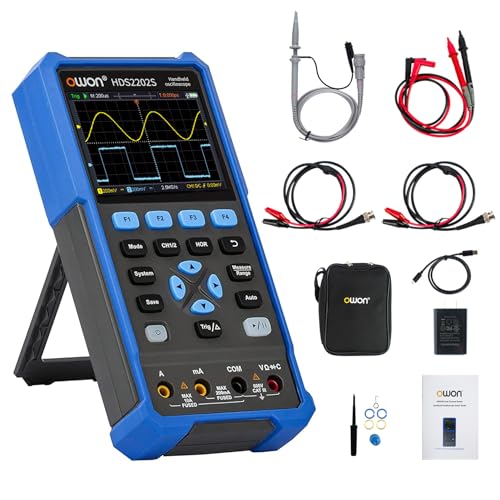
- ✓ Compact and lightweight
- ✓ Fast waveform refresh
- ✓ Versatile multi-functionality
- ✕ Battery life could improve
- ✕ No standalone batteries included
| Display | 3.5-inch high-resolution color LCD with high contrast |
| Bandwidth | 200 MHz |
| Real-time Sampling Rate | 1 GSa/s |
| Waveform Refresh Rate | up to 10,000 wfrms/s |
| Channels | Dual input channels |
| Battery | Two 2600mAh 3.7V lithium-ion batteries, approximately 6 hours of continuous use |
The moment I picked up the OWON HDS2202S, I immediately noticed how lightweight and compact it is, yet it packs a punch with its 200MHz bandwidth. It feels sturdy in your hand, thanks to its solid casing and thoughtfully placed buttons that are easy to navigate.
The high-resolution color LCD display really makes waveform details pop, especially outdoors or in bright environments.
One feature that truly stands out is the support for up to 10,000 waveform refreshes per second. That means you can see even the tiniest glitches in real time without lag or blurring.
Switching between channels and adjusting settings is smooth, thanks to the intuitive interface and auto-measure functions. The built-in arbitrary waveform generator is a bonus, letting you create complex signals right on the device.
Battery life is surprisingly good for a portable device—around six hours of continuous use with two 18650 batteries. I appreciate how easy it is to swap batteries out in the field, especially since it doesn’t rely on standalone lithium batteries.
The multimeter function is precise, with True RMS measurement, making it perfect for diagnosing electronics on the go. The USB-C port also makes connecting to a PC or power bank simple and convenient.
Overall, this oscilloscope feels like a real workhorse with a lot of features packed into a handheld design. It’s ideal for automotive, outdoor maintenance, or quick troubleshooting.
The only downside? Its power management, while decent, would be even better with a longer battery life for extended field work.
PicoScope 2204A-D2 Digital Oscilloscope, 2 Channels, 10 MHz

- ✓ Compact and travel-friendly
- ✓ User-friendly software
- ✓ Versatile analysis tools
- ✕ Limited for high-frequency signals
- ✕ Not automotive compatible
| Bandwidth | 10 MHz |
| Sampling Rate | 100 MS/s (MegaSamples per second) |
| Memory Depth | 8 kS (kiloSamples) |
| Vertical Resolution | Up to 12 bits |
| Channels | 2 |
| Connectivity | USB 2.0 (compatible with USB 3.0/3.1) |
As soon as I plugged in the PicoScope 2204A-D2, I was immediately impressed by how compact and lightweight it feels, almost like carrying a high-tech USB stick. Its sleek design with a sturdy, matte finish makes it a pleasure to handle, and the USB connection means I don’t need extra power supplies or bulky hardware.
The real game-changer for me was the 10 MHz bandwidth paired with the 100 MS/s sampling rate. It’s perfect for quick troubleshooting and detailed signal analysis without overwhelming my laptop’s resources.
The 8 kS capture memory lets me record longer signals, which is great when you’re trying to spot elusive glitches or transient issues.
I appreciated the intuitive PicoScope 7 software, compatible with Windows, Linux, and Mac. The interface is user-friendly, and the software offers advanced tools like math functions, filtering, and serial decoding right out of the box.
It’s like having a professional-grade oscilloscope at a fraction of the cost, and the continuous updates keep the software fresh and reliable.
The digital trigger options and mask limit testing make it easier to catch specific events or anomalies, saving me time during debugging. Plus, the ability to generate waveforms and perform spectrum analysis adds versatility that I didn’t expect from a device this size.
On the downside, it’s not suitable for automotive applications, but for small-scale projects, electronics prototyping, or educational purposes, it’s a solid choice. The only minor hiccup was the limited bandwidth for very high-frequency signals, but for most hobbyist and professional tasks, it’s more than enough.
What is a PC Oscilloscope and How Does it Work?
The impact of PC oscilloscopes is significant, as they facilitate precise troubleshooting and development in electronic projects. For example, according to a survey by TechRepublic, 78% of electrical engineers use oscilloscopes as their primary tool for debugging circuits (TechRepublic, 2021). The ability to visualize complex waveforms in real-time allows users to identify issues such as signal distortion, noise, and timing errors, which can be critical in ensuring the reliability of electronic systems.
Furthermore, PC oscilloscopes offer several benefits, including the ability to easily store and share waveform data, perform automated measurements, and integrate with other software tools for comprehensive analysis. They can also be cost-effective, as many options are available that range from budget-friendly models for hobbyists to high-performance versions suitable for professional use. Additionally, the portability of PC oscilloscopes makes them ideal for fieldwork, where users can diagnose issues on-site using a laptop or tablet.
To maximize the advantages of a PC oscilloscope, users should follow best practices such as ensuring proper grounding to avoid noise interference, using appropriate probes for the signal being measured, and regularly updating software for enhanced functionality. Additionally, understanding the specifications and limitations of the chosen oscilloscope will help users select the best model for their specific needs, ensuring optimal performance in their applications.
What Features Are Essential in the Best PC Oscilloscope?
The essential features to consider in the best PC oscilloscope include:
- Bandwidth: The bandwidth of an oscilloscope determines the range of frequencies it can accurately measure. A higher bandwidth allows the device to capture fast signals without distortion, which is critical for applications involving high-frequency components.
- Sampling Rate: The sampling rate refers to how often the oscilloscope samples the signal per second, measured in samples per second (S/s). A higher sampling rate provides more data points, resulting in a more accurate representation of the signal waveform, especially for rapidly changing signals.
- Vertical Sensitivity: Vertical sensitivity is the smallest voltage change that the oscilloscope can detect, typically measured in volts per division. This feature is crucial for accurately measuring small signals without losing resolution, ensuring that even subtle variations are captured.
- Input Channels: The number of input channels available on an oscilloscope determines how many signals can be analyzed simultaneously. More channels allow for complex analysis of multiple signals, which is particularly beneficial in troubleshooting and multi-signal applications.
- Software Compatibility: The best PC oscilloscopes come with user-friendly software that enhances functionality, allowing for signal visualization, data analysis, and remote control. Compatibility with various operating systems and support for advanced features like FFT analysis is also important.
- Triggering Options: Triggering options allow the oscilloscope to stabilize and capture repetitive signals accurately. Advanced triggering capabilities, such as edge, pulse width, and logic triggering, enable the user to isolate specific events for detailed analysis.
- Portability: Portability is a significant feature for users who need to perform measurements in different locations. Devices that are compact and lightweight, or that offer USB connectivity for easy integration with laptops, provide greater flexibility for fieldwork or laboratory use.
- Memory Depth: Memory depth indicates how much data the oscilloscope can store for each capture. A greater memory depth allows for longer signal captures at high sampling rates, which is essential for capturing transient events without losing important data.
- Display Quality: A high-resolution display enhances the usability of a PC oscilloscope, making it easier to view waveforms and measurements clearly. Features like multi-channel display and zoom functionality can significantly improve the analysis process.
- Price and Support: The cost of a PC oscilloscope can vary widely, so balancing features with price is important. Additionally, reliable customer support and warranty options can enhance the overall value by ensuring assistance is available when needed.
How Do PC-Based Oscilloscopes Compare to Traditional Benchtop Models?
| Feature | PC-Based Oscilloscopes | Traditional Benchtop Models |
|---|---|---|
| Price | Generally more affordable, suitable for hobbyists and students. | Higher cost, usually aimed at professionals and serious engineers. |
| Portability | Highly portable, requires a laptop or PC, easy to carry around. | Less portable, often bulky and designed for stationary use. |
| Functionality | Often includes advanced features like software integration and data analysis. | Typically offers robust performance with reliable hardware features. |
| User Interface | Interface can vary widely depending on the software used, may require learning curves. | Standardized interfaces, often more intuitive for immediate use. |
| Bandwidth | Often offer lower bandwidth options, sufficient for most hobbyist applications. | Usually provide higher bandwidth for professional applications. |
| Sample Rate | Varies widely; can be limited by the PC’s performance. | Generally have higher, consistent sample rates tailored for precision. |
| Ease of Use | May require software installation and configuration, which can be complex. | Designed for quick setup and use, often with physical controls. |
| Calibration | May require user calibration and adjustments. | Often come factory calibrated and are easier to maintain. |
| Support and Community | May have less community support, dependent on software. | Typically have strong manufacturer support and a large user community. |
What Are the Advantages of Using a PC Oscilloscope Over Standalone Units?
Using a PC oscilloscope offers several advantages over traditional standalone units.
- Higher Display Resolution: PC oscilloscopes leverage the high-resolution screens of computers, providing clearer and more detailed waveforms. This enhanced visibility allows for more precise analysis and observation of signal variations, which is crucial for detailed diagnostics.
- Advanced Software Features: Many PC oscilloscopes come with sophisticated software that offers additional features such as advanced triggering, data logging, and complex mathematical operations. This software can significantly enhance the user’s ability to analyze and manipulate signals, making it easier to troubleshoot complex electronic circuits.
- Storage and Data Management: PC oscilloscopes benefit from the vast storage capacity of computers, allowing users to easily save, retrieve, and organize data. This facilitates long-term projects and experiments, as well as the ability to share data with colleagues or integrate it into reports.
- Cost-Effectiveness: Often, PC oscilloscopes are more affordable than standalone units, especially when considering the additional costs of upgrading or purchasing additional hardware. This makes them an attractive option for hobbyists and professionals looking to maintain a budget while still accessing high-quality measurement tools.
- Portability and Versatility: With many PC oscilloscopes being USB-connected, they offer greater portability than traditional bench oscilloscopes. Users can take their measurement setup to different locations easily, and they can also utilize the oscilloscope on different computers, providing flexibility in various working environments.
- Real-Time Analysis and Processing: The computational power of modern PCs allows for real-time data processing and analysis that can be more extensive than that of standalone oscilloscopes. This means users can perform complex calculations and visualizations on the fly, enhancing their ability to interpret results immediately.
What Common Applications Can a PC Oscilloscope Be Used For?
The common applications for a PC oscilloscope include:
- Signal Analysis: PC oscilloscopes are widely used for analyzing electrical signals in various applications, such as audio electronics, telecommunications, and signal processing. They allow engineers to visualize waveforms, measure amplitude, frequency, and other signal characteristics, enabling effective troubleshooting and design optimization.
- Education and Training: Many educational institutions utilize PC oscilloscopes in physics and engineering courses to teach students about waveforms, signal behavior, and electronic circuits. The user-friendly interface and the ability to display complex data help students grasp essential concepts in electronics.
- Embedded System Development: Engineers working on embedded systems often use PC oscilloscopes to debug and test microcontrollers and other components. By monitoring the output signals and verifying timing requirements, developers can ensure that their systems operate correctly and efficiently.
- Automotive Diagnostics: In the automotive industry, PC oscilloscopes are invaluable for diagnosing issues in electronic control units (ECUs) and sensors. They help technicians monitor signals from vehicle sensors and actuators, assisting in the detection of faults in the vehicle’s electrical system.
- Research and Development: Researchers in fields such as telecommunications and control systems use PC oscilloscopes to analyze experimental data and verify theoretical models. The ability to capture and analyze transient signals makes them essential tools for validating new technologies and methodologies.
How Do You Select the Right PC Oscilloscope for Your Needs?
Selecting the right PC oscilloscope involves considering several key factors that align with your specific measurement needs.
- Bandwidth: The bandwidth of an oscilloscope determines the frequency range it can accurately measure. For applications involving high-frequency signals, a higher bandwidth is essential, as it allows for precise capturing of fast transients and complex waveforms.
- Sample Rate: The sample rate, measured in samples per second (S/s), dictates how often the oscilloscope samples the input signal. A higher sample rate is crucial for accurately reconstructing fast-changing signals, particularly in digital applications where signal integrity is paramount.
- Input Channels: The number of input channels on an oscilloscope dictates how many signals you can analyze simultaneously. For more complex systems or multi-channel applications, having multiple channels can provide a complete view of the interactions between different signals.
- Memory Depth: Memory depth refers to the amount of data the oscilloscope can store for each capture. A deeper memory allows for longer recording times and more detailed analysis of the waveform, which is particularly beneficial when examining slow signals or capturing events over extended periods.
- Display Features: The quality of the display, including resolution and screen size, affects the visibility and usability of the oscilloscope. A clear and high-resolution display makes it easier to interpret waveforms, while features like multi-touch capabilities can enhance user interaction and efficiency.
- Software Compatibility: Many PC oscilloscopes come with software that enhances functionality, such as advanced analysis tools and data export options. Ensuring that the software is user-friendly and compatible with your operating system can significantly improve your overall experience and productivity.
- Portability: If you need to use the oscilloscope in different locations, portability becomes a factor. Compact and lightweight designs are easier to transport, while battery-operated models can provide flexibility for fieldwork.
- Price: The cost of oscilloscopes can vary widely based on features and performance. It’s important to balance your budget with the necessary specifications to ensure you get the best value for your specific application without compromising on essential capabilities.
Which Brands Are Recognized for Quality PC Oscilloscopes?
Several brands are well-recognized for their quality PC oscilloscopes, each offering unique features and specifications.
- Tektronix: Tektronix oscilloscopes are known for their reliability and precision in measurement. They offer a wide range of models suitable for both general-purpose and specialized applications, with advanced features like high bandwidth and deep memory which are crucial for capturing fast signals.
- Keysight Technologies: Keysight oscilloscopes are favored for their user-friendly interfaces and powerful analysis tools. They provide software integration that enhances functionality, allowing users to perform complex measurements and analyses with ease, making them ideal for both educators and professionals.
- Rigol: Rigol is celebrated for providing high-quality oscilloscopes at competitive prices, making them accessible for hobbyists and students. Their products often include features typically found in more expensive models, such as high sampling rates and various triggering options, offering great value for the performance.
- Owon: Owon oscilloscopes are known for their portability and ease of use, often designed with a focus on mobile applications. They provide solid performance for basic measurements and are equipped with USB connectivity for easy integration with PC software, appealing to users looking for convenience.
- Siglent: Siglent oscilloscopes are recognized for their innovative technology and high-performance specifications at reasonable prices. Their models typically offer a wide range of bandwidths and sample rates, along with advanced features like waveform recording and playback, making them suitable for both academic and research applications.